Aurora Borealis formal dinner dress code
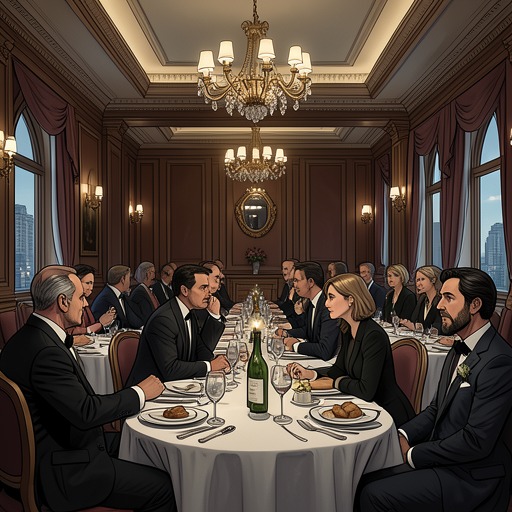
The Woman in Cabin 10Aurora Borealis formal dinner dress code establishes formal attire for dinner aboard Aurora Borealis, making an ordinary meal part of the ship’s carefully staged luxury. The novel gives no precise list of acceptable garments; its emphasis falls instead on the pressure the expectation creates, especially for Laura Blacklock, who must translate an extravagant standard into a wardrobe she can afford.
The rule and the evening schedule
When Camilla Lidman welcomes passengers aboard, she invites them to a presentation about the vessel and its facilities at seven in the evening, ahead of dinner at eight. The formal dinner requirement is conveyed to Laura by Rowan Lonsdale, who translates the word “formal” into something much more demanding. The schedule places the rule within a broader ritual of onboard hospitality: passengers are expected not simply to eat, but to prepare for an evening occasion.
Laura’s wardrobe calculation
Rowan Lonsdale recommends that Laura rent at least seven evening dresses so she will not have to repeat an outfit. Laura rents only three, explaining that Rowan Lonsdale is not offering to pay the cost. The difference between the recommendation and what Laura can afford makes the dress code a practical burden as well as a social expectation: complying means spending money and planning a rotation of clothes for the voyage.
For her first formal dinner, Laura chooses a long, narrow slip in dark gray satin, with sequined leaves scattered across the right shoulder. She leaves behind the shop’s most extravagant option, a long silver-white sheath covered in crystal studs, because she is not yet confident enough to wear it among passengers whose standards she does not know. Her decision is an attempt to meet the requirement without making herself the most conspicuous person in the room; even the comparatively restrained dress carries a small glittering detail.
Formality as performance
The rule helps turn clothing into a visible measure of belonging aboard the ship. Laura’s uncertainty about how dressed-up other passengers will be, her limited selection, and her cautious choice of gown all show that “formal” has no simple, self-evident boundary for her. Its force lies partly in the need to anticipate other people’s judgments before she has even seen the dinner crowd.
The expectation also sits against the vessel’s polished hospitality and luxury. Laura is invited to a scheduled presentation before dinner, while the ship’s welcome is delivered with practiced warmth by Camilla Lidman. Within that setting, evening dress is one more part of the passenger experience to be managed and displayed. The novel’s account remains focused on Laura’s preparation rather than on any formal inspection or stated penalty: the dress code matters through the planning, expense, and self-consciousness it produces.